CLAT 2025: Surprises, Strategies, and the Road Ahead
- CLAT Mentor Neeraj Sir

- Dec 1, 2024
- 2 min read
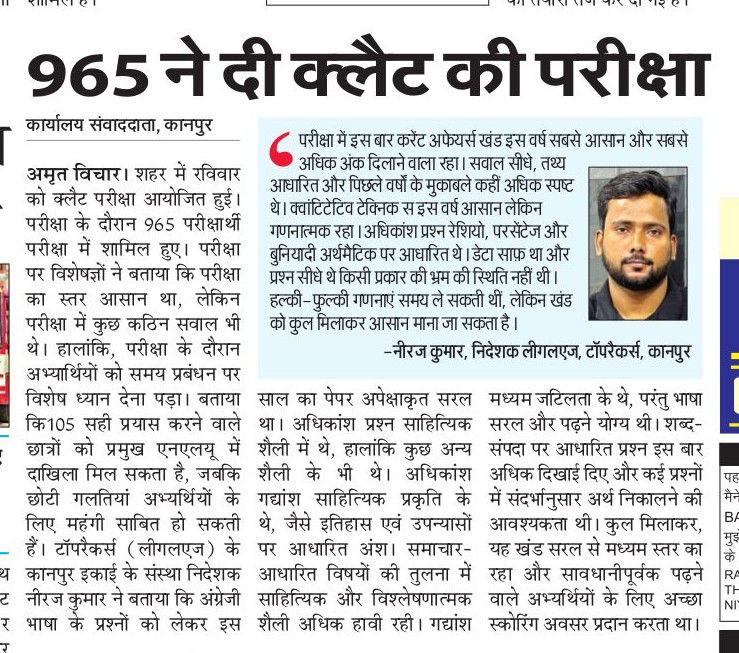
The wait is finally over. Today, CLAT 2025 was conducted across 139 centers nationwide, and the atmosphere was electric. After months of anticipation—especially following the release of the Consortium’s sample papers—we finally have the full picture of what this year’s aspirants faced.
If I had to summarize the exam in one sentence: It was a paper that rewarded accuracy over pure endurance.
Against many expectations, the overall difficulty level leaned toward "Easy," but as any seasoned mentor will tell you, an easy paper brings its own set of challenges—primarily sky-high cutoffs and a razor-thin margin for error.
The "Curveballs" in a Straightforward Paper
Even in an easy paper, there are always talking points. This year, the biggest surprise was the re-emergence of Analytical Reasoning. Seeing a seating arrangement passage in the Logical Reasoning section was a notable deviation from the trends of recent years. It serves as a reminder that the Consortium always keeps a few tricks up its sleeve.
Here is my section-by-section breakdown of how the afternoon unfolded:
1. English Language: The Scoring Zone
This section was a breath of fresh air. With passages like "How to Improve Your Life," the focus was on contextual clarity. The questions were direct and didn’t demand the heavy interpretation we sometimes see, making this a vital scoring area for most of my students.
2. Logical Reasoning: A Mix of Old and New
As mentioned, the mix of Critical and Analytical Reasoning made this section "Moderate." The inclusion of seating arrangements meant that students who had practiced traditional logic alongside passage-based reasoning had a distinct advantage.
3. Legal Reasoning: Where Knowledge Met Logic
The passages covered heavy-hitters like the Right to Privacy, the 42nd Amendment, and Contract Law. What I found interesting was the hybrid nature of the questions—they required students to blend their General Knowledge with Legal Comprehension. It wasn't just about reading; it was about applying what you know.
4. Current Affairs & GK: Balanced and Pivotal
From Article 370 to the Olympics and the Shakti Scheme, the GK section was well-rounded. While some answers could be derived from the text, a strong foundation in current affairs was essential to move through this section quickly.
5. Quantitative Techniques: The Time Thief
While the math wasn't "hard," it was certainly time-consuming. Topics like dearness allowance and percentage-based calculations required steady nerves. Those who managed their time effectively here likely secured their spot in the top brackets.
Looking Forward: Accuracy is Everything
In a paper like this, your biggest enemy isn't the difficulty—it’s the "silly mistake." Because scores are likely to be very close, a single misplaced mark could mean a difference of hundreds in rank.
To all the aspirants: Take a deep breath. You’ve run the marathon. Whether you are analyzing your performance or shifting your focus to AILET 2025 next week, remember that this is just one step in your journey to becoming a legal professional.
We wish you all the very best for the results!


Comments