CLAT: A Vision not Achieved

Updated: Feb 5
The Great Leap: How the BA LLB Redefined the Indian Legal System
For decades, legal education in India was viewed as a "supplementary" degree—a three-year detour taken by graduates who were often undecided about their professional futures. However, the 1987 reform, which introduced the integrated five-year BA LLB program, did more than just shave a year off the academic calendar; it fundamentally re-engineered the DNA of the Indian legal professional.
The Interdisciplinary Leap: Breaking the Silos
The most significant contribution of the BA LLB was the destruction of "legal isolationism." Under the traditional model, law was taught in a vacuum. The integrated model operated on a different philosophy: to understand the law, one must first understand the society it governs.
By weaving Humanities (Political Science, Sociology, History, and Economics) into the first two years of the degree, the curriculum transformed students into "Social Engineers." A student studying Constitutional Law was now simultaneously studying the Political History that necessitated it. This holistic approach ensured that the new generation of lawyers didn't just know the "what" of the law, but the "why" behind it.
Synchronisation with Global Markets
The timing of the BA LLB revolution was fortuitous. As India opened its economy in 1991, the demand for sophisticated legal counsel skyrocketed. The traditional three-year graduates were largely groomed for the courtroom (Litigation), but the five-year integrated graduates were uniquely equipped for the Boardroom.
The BA LLB produced a workforce that understood international trade, intellectual property, and corporate governance. This alignment with the needs of a globalised India ensured that the legal profession became one of the most lucrative and sought-after sectors in the country.

CLAT: A Vision not Achieved
The beginnings:
It must have been a sight for Prof. (Dr.) N.R Madhava Menon sees his dream come true brick by brick. It was likely a very pleasant day on 25th February 1984 when the first foundation stone was laid on a 16-acre plot of land in Nagarbhavi. Today the same campus has grown to be called the “Harvard of the East” the campus has grown to 23 acres with multiple academic blocks it was not just another law collage it was meant to be the pioneer of legal education in India, and it truly was, followed by NLSIU, it was NLIU BHOPAL (1997), NALSAR HYDRABAD (1998), etc. Legal education in India was transformed by the formation of NLU’s
Origin of CLAT:
Till 2007, each National Law University (NLU) conducted separate entrance examinations to select students for their various degree programs. However, this caused a great deal of hardship and inconvenience to law aspirants, as each candidate had to take more than 10 separate entrance examinations. The practice of having separate entrance examinations was strongly condemned by this Hon’ble Court in Varun Bhagat v Union of India and Others (Supra) prompting the Ministry of Human Resource Development (‘MHRD’), the University Grants Commission (‘UGC’), the Bar Council of India (‘BCI’) and the Vice Chancellors of seven (7) NLUs (NLSIU, NALSAR, WBNUJS, NLIU, NLUJ, HNLU and GNLU) to formulate a more rational and student friendly method of selecting the most promising candidates with legal aptitude. A series of meetings and discussions resulted in an agreement amongst the NLUs to admit students based on one common entrance examination conducted every year.
On 23.11.2007, the Vice-Chancellors of the NLUs signed a Memorandum of Understanding (‘MoU – 2007’) declaring the institution of a Common Law Admission Test (CLAT).
CLAT was born in the hope of solving the issue of segregation, confusion and misalignment of values between different NLU’s. Little did the Supreme Court, or anyone had idea that the problem which they were trying to solve was not yet solved but had evolved into something just a bit more organised. In the year 2008, the first CLAT was conducted by NLSIU Bangalore. It was a well-calculated and decently conducted exam, which was long overdue for students. There must have been a sense of hope and a feeling of lightness for everyone, but the dark clouds were just around the corner for CLAT.
The Rotational system:
From the very first CLAT exam till very late in story of the exam there was a customary practice established the practice in itself isn't something very astonishing or complex rather it is very simple it's like a common game of passing the ball but instead of a ball what's being passed here is the responsibility of conduction of the only national level entrance for legal education hence we can call this system in more respectful terms “the rotational system” which was not based on any such logic or prudent discussion but on the lines of trust that each participating university would deliver its part for the proper functioning of the “MoU - 2007” it was this lack of discussion and thinking that proved to be fatal for both students and participating universities in the coming years.
The functioning of CLAT and the rotational system
The Vice-Chancellors of NLUs signed a Memorandum of Understanding (‘MoU–2007’) declaring the institution of a Common Law Admission Test (CLAT), the salient features of which are enumerated below:
(a) The Common Law Admission Test was to be the single entrance examination for all the participating NLU’s, and students would be admitted based on scores obtained in this test.
(b) It was to be held each year by different NLU’s (in rotation), based on their year of institution.
(c) The overall supervision and policy making of CLAT would lie with
the ‘Core-Committee’ (‘CLAT-CC’), comprising the Vice- Chancellors of all participating universities (as its members). The CLAT-CC would be headed by the Vice-Chancellor of the Organising University as its Convenor.
(d) The planning, preparation and execution of the entrance test
would lie with the ‘Implementation Committee’ (‘CLAT-IC’) comprising the Vice-Chancellor of the Organising University as the Chairperson and one member from each participating university (nominated by their respective Vice-Chancellors).
(e) The proceeds received from the application fees collected from candidates would be allocated in the following manner:
i. The Organising University would retain 50% of the proceeds to meet the expenditure for conducting the examination; and
ii. The remaining 50% would be shared amongst the participating NLUs.
(f) The scores obtained through the Common Law Admission Test could be provided to non-participating universities and colleges upon the payment of a fee.
The Growth Trajectory
As the first CLAT exam unfolded, it was clear that this was already going well, with a good number of applicants. The 1st Edition of the entrance test was conducted by NLSIU on 11.05.2008. The test scores were used for admission to 11 NLUs, including four (4) non-participating universities, for the academic year 2008-09. Since then, CLAT has been conducted a total of eight (11) times for academic years from 2008-18. Over the years, there has been a manifold increase in the number of candidates appearing for the admission test, reflecting the growing importance of legal education and the prominence of law as a promising career option. The table encapsulates the growth in the number of NLU’s participating in CLAT over the years and the rapid increase in the number of students who write the CLAT exam each year.
S.No. | YEAR | PARTICIPATING UNIVERSITIES | TOTAL CANDIDATES |
1 | 2008 | 8 | 10773 |
2 | 2009 | 11 | 13588 |
3 | 2010 | 11 | 16350 |
4 | 2011 | 11 | 21353 |
5 | 2012 | 14 | 23881 |
6 | 2013 | 14 | 27627 |
7 | 2014 | 15 | 29628 |
8 | 2015 | 16 | 37358 |
9 | 2016 | 17 | 39415 |
10 | 2017 | 18 | 45213 |
11 | 2018 | 19 | 47382 |
It is clearly demonstrated that till 2018 CLAT was not only booming but it was literally adding tens of thousands of students each year Despite the growing popularity of CLAT, its planning and execution over the years has been marred with serious institutional lapses and inefficiencies, such as arbitrary and sub-standard question papers, incorrect questions and answers, questions that have no reasonable nexus to a candidates’ aptitude for the study of law, wrongful allotments of seats, unnecessary delays and an opaque administration that fails to comply with basic standards of transparency and the norms underlying the RTI Act. As a result, there was finally a petition logged in the Hon’ble Supreme Court.
Disha Panchal v. Union of India (2018)
CONTEXT: The responsibility to conduct CLAT in 2018 was given to NUALS KOCHIN since 2015. The mode of examination was online mode; there were some hooks and nooks sometimes, but nothing compared to the blunder of 2018
The CLAT of 2018 was fraught with various imperfections. The major defects found are categorised as follows:
i. The majority of complaints relate to the failure of the initial login. Multiple log in appears to have affected the performance of the system. Software and hardware efficiency will depend upon server capacity and efficacy. The Service Provider was duty-bound to provide trouble-free software. A common defect of initial login failure must have arisen from the hardware, software or network deficiencies.
ii. Conduct of a test of this magnitude without providing efficient software and computers to the candidates has resulted in avoidable interruptions in answering questions.
iii. Infrastructural defects like failure of the air conditioning systems, which stood in the way of the best performance of students in many centres in the examination conducted at the peak of summer.
iv. Power failure, which affected many centres, has resulted in loss of time and disturbance to the concentration of mind required for a smooth performance in a competitive test.
v. Failure of invigilators to facilitate re-login, which is essential for availing the benefit of the extended time granted to compensate for lost time arising from power failure, system hanging, etc.
vi. Failure to grant extended time even in cases where the first login attempt failed or in the subsequent attempt/s, the time obtained is lower than what is prescribed, though such reduction was only marginal.
The Judgment (June 13, 2018)
A Vacation Bench consisting of Justices U.U. Lalit and Deepak Gupta delivered a landmark order that balanced the rights of affected students with the need to maintain the academic calendar.
No Re-test: The Court refused to cancel the exam or order a re-test, noting that it would cause "undue hardship" to the majority of the 54,000+ candidates.
The Normalisation Formula: In a first for Indian entrance exams, the Court ordered a statistical normalisation to award compensatory marks to the 4,690 candidates who proved they lost time. This was based on the "answering efficiency" of the student during the time they did have.
Grievance Redressal Committee: The Court appointed an independent committee chaired by Justice M.R. Hariharan Nair (Retired High Court Judge) to audit every single technical complaint.
The "Institutional" Verdict
Beyond the immediate relief, the 2018 judgment contained a stern directive that changed the history of NLUs:
Slamming the Rotational Model: The Court observed that entrusting a different university every year was "unprofessional" and lacked accountability.
MHRD Intervention: It directed the Ministry of Human Resource Development (MHRD) to appoint a committee to revisit the entire model of conducting CLAT.
Birth of the Consortium: Under this intense judicial pressure, the NLUs fast-tracked the creation of the Consortium of National Law Universities, which was formally registered as a Society just months later (March 2019).
The birth of the Consortium of National Law Universities (NLUs) marked a fundamental shift from ad-hoc administration to institutional permanence in Indian legal education. For over a decade, the Common Law Admission Test (CLAT) was governed by a fragmented "rotational system." This model, however, was frequently plagued by administrative inconsistencies and technical failures, most notably in 2015 and 2018. Following intense judicial scrutiny in landmark cases like Shamnad Basheer v. Union of India and Disha Panchal v. Union of India, the Supreme Court pushed for a professionalised, permanent body to ensure transparency and stability. Responding to this need, the Vice-Chancellors of 18 NLUs formally established the Consortium on August 19, 2017. With the setting up of a Permanent Secretariat at NLSIU Bengaluru in 2018 and its formal registration as a legal society in March 2019, the Consortium transitioned from a mere coordinating committee into a robust regulatory entity, dedicated not just to the conduct of CLAT, but to the long-term standardisation and excellence of legal education across India.
NLAT Controversy:
As the students and the administration were trying to grapple with the aftermath of the 2018 controversy, they were again hit by another shock in the form of Covid 19 this further led to problems within the consortium of Nlu’s. This time, it was a rare kind of situation where the captain decided to drill holes in the hull.
Rakesh Kumar Agarwalla v. National Law School of India University (NLSIU), Bengaluru (2020)
CONTEXT:
National Law School of India University (NLSIU), a member of CLAT Consortium, announced its own entrance test, NLAT, via press release on 3rd of September 2020, as CLATwas postponed several times due to various reasons, including lockdown in some states. NLAT was challenged in the Jharkhand High Court on 4th September. The Court dismissed the petition on 11th September. Meanwhile, separate proceedings were initiated in the Supreme Court. On 11th September, the Supreme Court allowed the conduct of NLAT on 12th September, provided that the results would be subject to its subsequent orders. Hearings through videoconferencing took place onthe 16th and 17th. Judgment was reserved on the 17th and pronounced on the 21st of September 2020.
Decision of the Court: The Court quashed the conduct of NLAT and ordered NLSIU to conduct admissions to its courses this year through the CLAT. The Court also ordered that CLAT should be held without fail in accordance with all COVID-related guidelines and the admission process to be completed as soon as possible, along with the course to be started in mid-October 2020. The Supreme Court quashed NLAT with regard to the rights of aspirants and fairness, transparency and Integrity of the examination.
Ups and downs:
With the NLAT dispute settled it was again time to move forward the consortium took some necessary steps in terms of subject change and overhaul of the whole CLAT pattern to make it more aligned with the evolving legal landscape the total number of questions were cur from 200 to 150 and then further to 120, the biggest change came in form of type of questions as from previous one liner questions the pattern shifted to a comprehension passage based pattern. Now, there may exist room for debate on the points of language inclusivity, leaning towards a more pro-elite approach, but the period from 2020 to 2024 was a smooth ride until it was December of 2024.
The CLAT 2025 cycle was overshadowed by a series of administrative and academic blunders that the Supreme Court characterised as a "callous and casual" handling of a high-stakes national exam. This period was marked by a crisis of credibility, as students identified numerous errors in question framing—ranging from logically inconsistent puzzles to calculations requiring calculator-like precision—which forced the judiciary to intervene, ultimately leading to the deletion of seven questions and a chaotic, six-month delay in finalising the merit list.
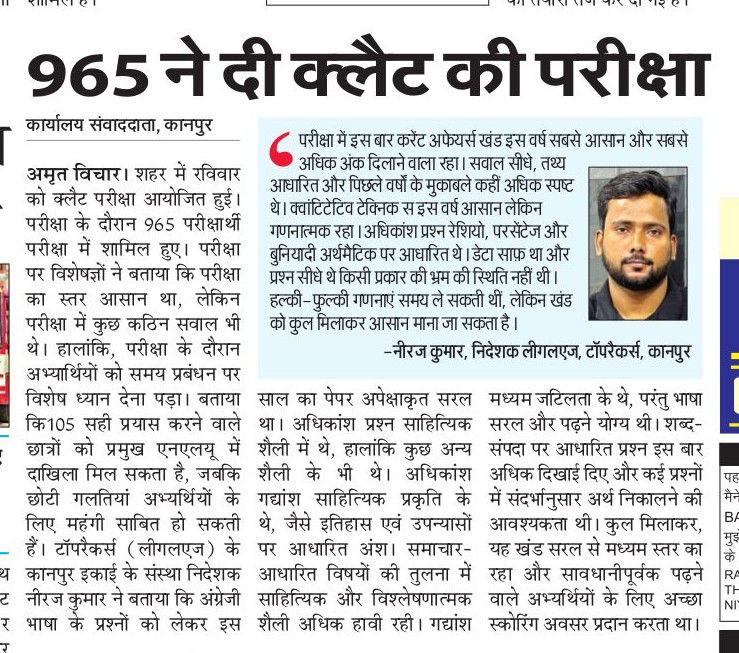
In stark contrast, the CLAT 2026 session provided a strong positive response and a much-needed institutional recovery for the Consortium. Demonstrating a renewed commitment to professionalism, the 2026 exam achieved a record 96.45% attendance and was widely praised for its balanced difficulty and near-flawless execution. The Consortium effectively restored student trust by ensuring an error-free paper (with only one question withdrawn) and streamlining the results process to an unprecedented nine-day window. By establishing an expert committee of international legal scholars for future reforms and maintaining a stable, transparent admission timeline, the Consortium successfully turned the 2025 debacle into a catalyst for long-overdue systemic improvement.
Way Forward: Reimagining CLAT as a Stable Public Institution
For CLAT to genuinely fulfil the reformist vision that accompanied the rise of National Law Universities, incremental corrections will no longer suffice. What is required is a structural reimagination of CLAT as a permanent, transparent, and professionally governed public institution.
First, there is a compelling case for providing statutory backing to the Consortium of National Law Universities. At present, the Consortium derives its authority primarily from consensus and judicial reinforcement rather than legislation. Statutory recognition would clearly define powers, responsibilities, and accountability mechanisms, reducing the need for repeated judicial intervention and insulating the examination process from ad-hoc decision-making.
Second, professionalisation of examination design and administration must be prioritised. CLAT should transition from being university-administered to being expert-driven. This entails permanent question-setting panels, psychometric validation of papers, pre-testing of questions, and independent audit mechanisms, features standard to other high-stakes national examinations. Reliance on temporary academic committees risks repeating past errors.
Third, the Consortium must institutionalise a robust grievance redressal and transparency framework. Time-bound disclosure of answer keys, reasoned explanations for corrections, and mandatory compliance with RTI norms should be non-negotiable. Transparency should not be reactive or crisis-driven, but embedded within CLAT’s operational architecture.
Fourth, concerns of equity and access must be addressed proactively. While comprehension-based testing reflects higher-order reasoning, complementary measures—such as multilingual accessibility, calibrated language complexity, and reduced coaching dependency—are essential to preserve CLAT’s character as a meritocratic yet inclusive examination. As publicly funded institutions, NLUs carry a constitutional obligation to widen, not narrow, access to opportunity.
Finally, the Consortium must adopt a forward-looking governance model that anticipates growth rather than responds to breakdowns. This includes long-term technological partnerships, stress-tested infrastructure, and independent oversight boards comprising legal academics, assessment experts, and public administrators. Institutional memory must be preserved through continuity, not reinvented each year.
If implemented sincerely, these measures can transform CLAT from a perpetually litigated examination into a stable gateway to legal education. The success of CLAT 2026 suggests that institutional learning is possible; the challenge now lies in converting episodic success into permanent design.
Author Note- Original concept and ideation by Neeraj Kumar. Written, structured, and edited by Aryan Bajpai.


Comments